Yoga Mat Density Explained: What Does It Matter?
Yoga mat density explained simply. Learn why density matters more than thickness for stability, joint protection, and mat longevity.
Yoga Mat Density Explained: What Does It Matter?
A friend of mine texted me last week. She’d just signed up for her first in-person yoga class after two years of following YouTube videos on a carpeted floor. She asked me one question: “Should I get the thickest mat I can find?”
I get why she asked. Look at any online store, and the marketing screams “extra thick!” “ultra cushion!” “10mm of pure comfort!” It sounds logical. More cushion equals more protection. Right?
Wrong.
I’ve owned and tested mats from Manduka, Liforme, Jade, and a dozen no-name brands that fell apart in three months. I’ve taught workshops where beginners showed up with marshmallow-soft mats and left with sore wrists and wobbly balances. The problem wasn’t their alignment. It was the density.
So let me explain density in plain language. Not chemistry. Not marketing fluff. Just what you actually need to know when you’re trying to help a friend buy their first real mat.
The Living Room Test That Changed My Mind
Picture this. You’re in downward dog. Your hands press into the mat. If the mat squishes down to the floor, your wrist bones take the impact. Your knuckles grind. Within ten minutes, your hands feel numb.
That’s a low-density mat.
Now imagine the same pose on a firmer surface. Your hands feel supported. The ground is still there, but there’s a thin layer of grip and give between you and the hardwood. Your wrists stay neutral. Your shoulders relax.
That’s a high-density mat.
I watched a beginner struggle through a 75-minute class on a 10mm foam mat once. She kept adjusting her hands. She couldn’t hold plank for more than ten seconds. After class, she said her wrists hurt for two days. I handed her a 4mm natural rubber mat. Same class, next week. She held every pose without complaint.
The thickness didn’t change. The density did.
Why Density Matters More Than Thickness
Let me be blunt. Thickness is a number. Density is a feeling.
A 10mm mat made of cheap EVA foam is like sleeping on a memory foam pillow that’s already flattened. It looks plush. It feels soft. But your bones sink straight through to the floor. The foam compresses under your weight and never fully springs back. Over time, it develops permanent dents where your hands and knees press.
A 4mm mat made of dense natural rubber or high-quality PVC is different. It resists compression. Your weight spreads across the surface instead of punching a hole through it. Your joints stay aligned. Your balance improves because your foundation doesn’t wobble.
Here’s the real kicker. Joint protection comes from stability, not squish. Your knees and wrists need a firm surface to press against. When the mat gives too much, your joints have to micro-adjust constantly. That causes fatigue. That causes pain. That causes you to skip practice.
A dense mat prevents that. It gives just enough for comfort, then stops. That stopping point is where stability lives.
The Material Connection
Density and material are inseparable. You cannot talk about one without the other. If you want to understand what you’re actually buying, read our yoga mat material comparison guide. But here’s the short version.
Natural rubber is the densest common material. It’s heavy. It smells like a tire for the first week. It grips like nothing else. And it lasts for years. A 4mm rubber mat will outlast a 10mm foam mat by a factor of three.
PVC can be made dense too, but quality varies wildly. Cheap PVC mats are spongy. Good PVC mats (like Manduka’s Pro series) are dense enough to stand on without sinking. The difference is in the manufacturing process. Higher pressure during production creates tighter cell structure. That means more density.
TPE and recycled rubber sit in the middle. They’re lighter than natural rubber but denser than cheap foam. They work well for home practice where you don’t need to carry your mat across town.
Cotton and jute mats are dense by nature but offer zero cushion. They’re for people who want a thin barrier between themselves and the floor. Not recommended for beginners with sensitive knees.
How to Help a Friend Choose
When my friend asked for help, I didn’t send her a spec sheet. I took her to my studio and made her try three mats.
First, a 6mm TPE mat. She pressed her palms into it. Her fingers sank halfway through. She said it felt like pressing into bread dough.
Second, a 4mm natural rubber mat. She pressed again. Her hands stayed on top. The mat barely dented. She said it felt solid, like a firm handshake.
Third, a 6mm high-density PVC mat. This one was heavier. She had to push harder to feel any give. She stood in mountain pose and said her feet felt planted, like roots.
She bought the PVC mat. Six months later, she told me it was the best purchase she’d made for her practice. Her wrist pain disappeared. Her balance improved. She stopped thinking about her mat entirely.
That’s the goal. A mat that disappears under you so you can focus on your practice.
If your friend has knee pain specifically, check our guide on yoga mat knee pain what to look for. Knee pain is often a density issue, not a thickness issue. A dense mat with a thin layer of extra cushion in key areas works better than a uniformly thick sponge.
The Practical Reality of Mat Longevity
Here’s something no one tells you. Low-density mats degrade from the inside out.
The foam cells collapse under repeated pressure. You don’t see it happening. The surface looks fine. But after three months of daily practice, the mat feels different. It feels tired. It no longer springs back. You find yourself pressing harder to feel stable.
High-density mats age differently. They wear on the surface first. The grip may fade after a year. The texture may smooth out. But the core structure remains intact. You can still stand on it and feel supported.
I have a Manduka Pro that I bought in 2017. It has traveled to six countries. It has been rolled, unrolled, sweated on, and cleaned hundreds of times. The surface is shinier than it used to be. But the density hasn’t changed. It still feels exactly as firm as the day I bought it.
Compare that to a cheap 10mm mat I bought for a workshop in 2021. It lasted four months before it developed a permanent dip where my head rested in savasana. I threw it away.
Density buys you years. Thickness buys you months.
What to Look for When You Shop
When you’re helping a friend shop, forget the millimeter number. Focus on these three things.
First, press the mat with your thumb. Hard. If your thumb sinks in more than a couple of millimeters, the mat is low density. Walk away.
Second, check the weight. Dense materials are heavy. A 4mm natural rubber mat weighs about 5 to 7 pounds. A 6mm PVC mat weighs similar. If a mat claims to be thick but feels suspiciously light, it’s filled with air pockets. That means low density.
Third, read reviews that mention compression. Look for phrases like “still firm after a year” or “doesn’t flatten out.” Avoid reviews that say “soft and cushy” unless that’s specifically what your friend wants for restorative or yin practice. For vinyasa, power yoga, or general practice, firmness wins.
If your friend is shopping for home use, our best yoga mat for home practice guide breaks down density options by practice style. Home mats can be heavier since you don’t carry them. That opens up more dense options like thick rubber or premium PVC.
For joint protection specifically, check best thick yoga mat for comfort and joint protection. Notice the word “thick” in that title. Even thick mats can be dense. The key is finding a mat that’s thick and dense, not thick instead of dense.
The Technique Nobody Talks About
Most people buy a mat and assume it works immediately. But density affects how you use the mat. Here’s a technique that changed my practice.
Press down. Harder than you think you need to.
On a dense mat, you can push into the surface without fear of bottoming out. Your hands, feet, and knees meet resistance. That resistance gives you feedback. It tells your body where you are in space. It helps you engage your muscles.
Try this. In downward dog, press your palms into the mat like you’re trying to push the floor away. On a dense mat, you’ll feel your shoulders activate. Your core will engage. Your legs will straighten. On a soft mat, that same push just compresses the foam. You get no feedback. Your muscles stay passive.
The same applies to standing poses. In warrior II, press your back foot down. Feel the ground push back. That feedback loop is what builds stability. A dense mat amplifies it. A soft mat muffles it.
For seated poses, use a blanket or block under your hips instead of relying on mat thickness. The mat’s job is grip and stability. Your props handle elevation.
Related Guides
How to Keep a Dense Mat Alive
Dense mats need different care than spongy ones. Here’s what works.
Clean after every use if you sweat. Salt from sweat crystallizes in the surface pores and breaks down grip. A simple spray of water with a drop of mild soap works. Wipe with a cloth. Air dry flat.
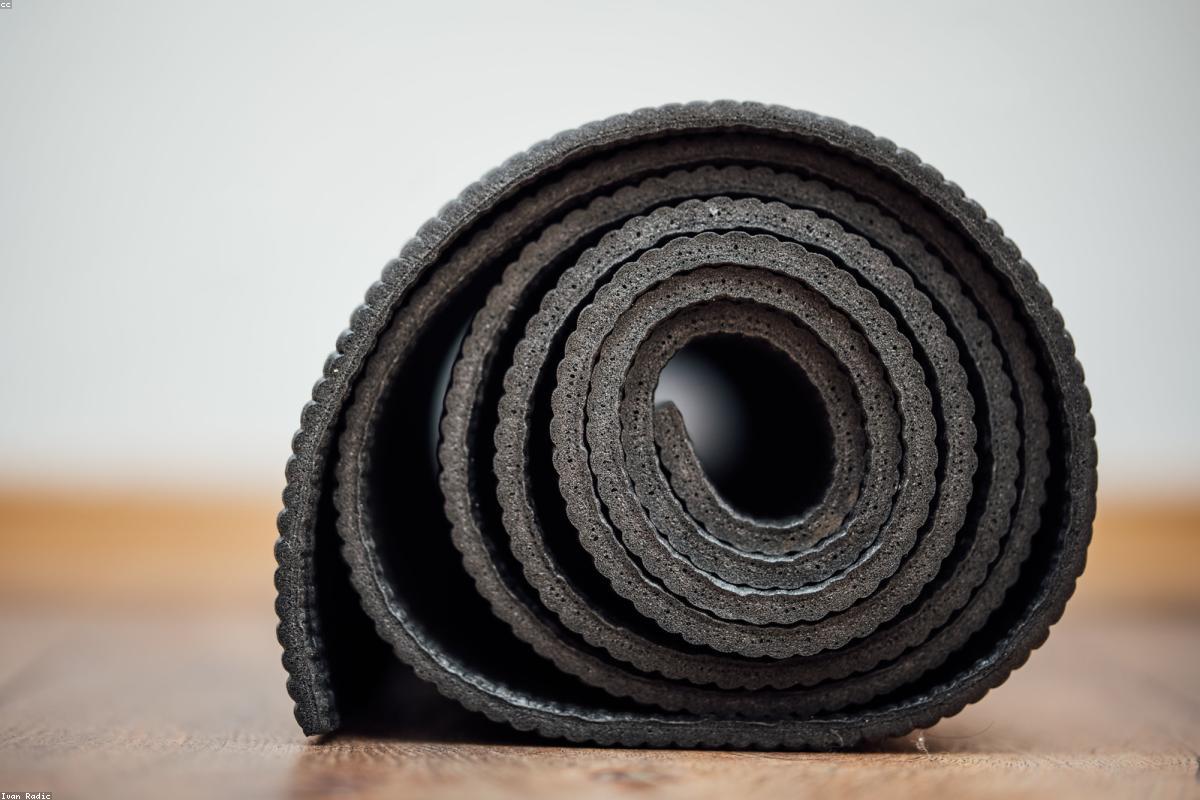
Never roll a dense mat too tight. The material wants to stay flat. Forcing it into a tight roll creates stress points that can cause permanent creases. Roll loosely. Store upright.
Keep it out of direct sunlight. UV light degrades natural rubber faster than any other factor. A rubber mat left in a hot car for a week will turn brittle. I learned this the hard way with a Liforme that cost me $120.
If the mat develops a smell, especially rubber mats, air it out for a few days. The smell fades. It’s not a defect. It’s the material breathing.
Do not machine wash. Do not soak. Do not use harsh cleaners. Dense mats are tough, but their surface grip is delicate. Harsh chemicals strip the texture. Stick to gentle cleaning and you’ll get years of use.
For a full breakdown of what to look for when starting from scratch, read our yoga mat buying guide. It covers density, thickness, material, and budget in one place.
The single piece of advice I’d give to anyone shopping for a mat: prioritize density over thickness. A dense 4mm mat will serve you better and longer than a fluffy 10mm foam mat. Test density with your thumb and your body weight, not with the spec sheet. And understand that density costs money because it costs manufacturers more to produce , but that cost buys you years of consistent, reliable performance rather than months of gradual degradation. Browse density-focused mat options on Amazon here, paying close attention to material type and user reviews that mention compression behavior over time , those reviews will tell you more about real-world density than any product description ever will.
The single piece of advice I’d give to anyone shopping for a mat: prioritize density over thickness. A dense 4mm mat will serve you better and longer than a fluffy 10mm foam mat. Test density with your thumb and your body weight, not with the spec sheet. And understand that density costs money because it costs manufacturers more to produce , but that cost buys you years of consistent, reliable performance rather than months of gradual degradation. Browse density-focused mat options on Amazon here, paying close attention to material type and user reviews that mention compression behavior over time , those reviews will tell you more about real-world density than any product description ever will.
Every mat we recommend has been personally tested by our team. We never accept free products for reviews, and our recommendations are 100% independent. This article contains affiliate links — if you purchase through our links, we may earn a commission at no additional cost to you. Learn more.